HDL Automation: Complete Guide to HDL KNX, Buspro and Smart Building Solutions
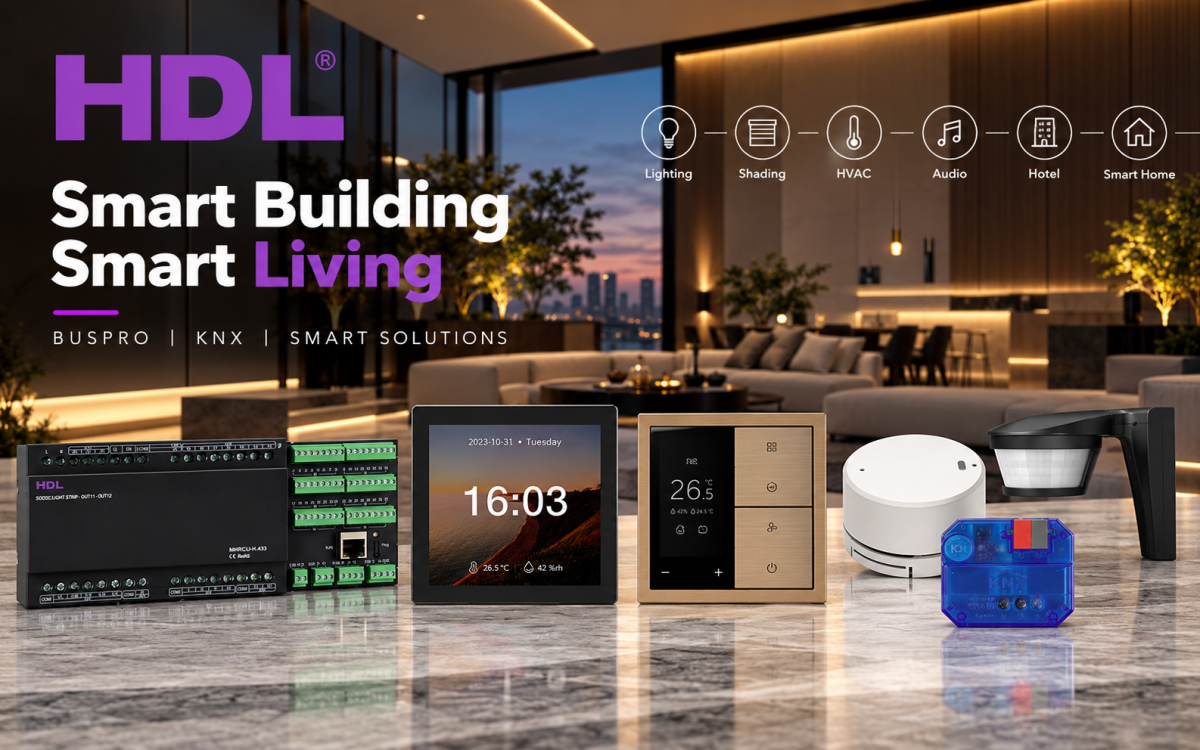
Discover HDL KNX actuators, Buspro automation, smart control panels, lighting systems, HVAC controllers, sensors, hotel room management and intelligent building solutions.
Modern buildings require intelligent systems that bring lighting, shading, heating, cooling, entertainment, and security-related functions together in a coordinated environment.
For homeowners, intelligent automation means convenience, comfort, and personalized control. For commercial developers and hotel operators, it also means better operational visibility, flexible system management, and opportunities to optimize energy consumption.
HDL Automation is an international manufacturer specializing in smart home, smart hotel, and commercial building automation technologies.
Unlike manufacturers offering only one building communication ecosystem, HDL provides several automation platforms, including its proprietary Buspro, Buspro Wireless, and standards-based KNX product ranges.
Its portfolio includes intelligent switches, touchscreen panels, relay and dimming actuators, curtain controllers, sensors, HVAC interfaces, audio systems, gateways, and hotel room management solutions.
At KNXbazzar, electrical contractors, automation engineers, KNX integrators, and professional buyers can explore HDL building automation devices and find suitable products for their projects.
Explore HDL Automation Products at KNXbazzar →
1. About HDL Automation: An International Building Automation Manufacturer
HDL Automation is a technology manufacturer headquartered in Guangzhou, China, specializing in intelligent control systems for residential, commercial, and hospitality applications.
The company traces its technical heritage to the development of digital dimming control technology during the 1980s.
Over subsequent decades, HDL expanded its activities into integrated building automation, developing its own control platforms, hardware modules, room interfaces, sensors, and system integration technologies.
According to HDL, its products and automation solutions are used across more than 100 countries and regions.
The company develops solutions for:
- Smart homes and luxury residences
- Apartments and residential developments
- Hotels and hospitality facilities
- Office buildings
- Commercial complexes
- Educational and public buildings
- Entertainment and multi-purpose venues
One of the distinguishing characteristics of HDL is its coverage of multiple communication technologies.
HDL’s building automation ecosystem includes proprietary wired and wireless solutions alongside an extensive range of KNX-compatible products.
The company joined the international KNX ecosystem in 2006 and has subsequently contributed to KNX technology through product development and testing activities.
Its product strategy emphasizes integrated functionality, configurable automation, and adaptable hardware designs for different project requirements.
2. HDL Automation Technologies: Buspro, Buspro Wireless and KNX
Understanding HDL’s three main automation platforms is essential before selecting equipment.
Although all three technologies can support intelligent building functions, their communication architecture, configuration methods, and integration requirements differ.
2.1 HDL Buspro: Proprietary Wired Building Automation
HDL Buspro is the company’s proprietary wired building automation platform.
It uses an HDL-specific communication system based on RS485 technology and is designed for controlling electrical and mechanical building functions.
A Buspro installation can incorporate compatible:
- Lighting actuators
- Dimming controllers
- Curtain and blind modules
- HVAC controllers
- Wall-mounted control panels
- Touchscreen interfaces
- Occupancy sensors
- Audio and entertainment devices
- Gateways and system interfaces
- Hotel room automation components
Buspro is particularly relevant to projects requiring a coordinated HDL automation ecosystem.
Typical applications include luxury villas, apartments, hotels, commercial interiors, and integrated multi-room installations.
Buspro products use HDL-specific communication and configuration requirements. They should not be assumed to connect directly to a KNX twisted-pair line.
Integration between Buspro and KNX requires an appropriate supported interface or gateway.
2.2 HDL Buspro Wireless: Flexible Wireless Automation
Buspro Wireless is HDL’s proprietary wireless automation platform.
It provides another way of connecting suitable intelligent building devices without relying exclusively on dedicated wired bus infrastructure.
Depending on the chosen equipment, wireless automation can support lighting, room control, shading, and related smart-home functions.
Buspro Wireless may be relevant for:
- Existing homes
- Renovation projects
- Spaces with limited wiring access
- Residential expansion
- Hybrid wired-and-wireless installations
Wireless system performance depends on device compatibility, radio coverage, building construction, interference, and the installation architecture.
Buspro Wireless is not equivalent to KNX RF, Zigbee, or Wi-Fi merely because all use wireless communication. Compatibility must be verified for each system.
2.3 HDL KNX: Open-Standard Building Automation
HDL KNX is the company’s product portfolio based on the internationally recognized KNX building automation standard.
KNX is an open, manufacturer-independent communication technology used for intelligent lighting, HVAC, shading, sensing, and building control.
HDL KNX products include actuators, sensors, room-control panels, input modules, system interfaces, and gateways.
Compatible HDL KNX devices can communicate with suitable products from other KNX manufacturers, including ABB, Schneider Electric, Theben, EAE, and Panasonic.
Professional KNX installations are generally commissioned using ETS (Engineering Tool Software).
This makes HDL KNX especially relevant for integrators who need to combine products from multiple manufacturers within a single automation system.
3. HDL Buspro vs. HDL KNX: Understanding the Differences
Before choosing HDL equipment, project engineers should consider whether an open KNX architecture or HDL’s proprietary Buspro ecosystem better matches the project’s requirements.
| Feature | HDL Buspro | HDL KNX |
|---|---|---|
| Communication | Proprietary HDL Buspro | International KNX standard |
| System ecosystem | HDL-focused | Multivendor KNX |
| Engineering tools | HDL-specific software | ETS |
| Third-party integration | Through compatible interfaces and gateways | Native KNX interoperability with compatible devices |
| Room control | HDL Buspro panels and controllers | HDL KNX panels and compatible KNX devices |
| Lighting and HVAC | Supported HDL modules | Supported KNX modules |
| Typical applications | Integrated homes, hotels, commercial installations | Open-standard residential and commercial KNX projects |
Neither platform is universally superior.
Buspro may be attractive for projects requiring a coordinated HDL-specific solution, particularly when room interfaces, hospitality components, and proprietary integration features are priorities.
KNX may be preferable where open-standard interoperability, multivendor procurement, and ETS-based commissioning are central requirements.
4. HDL Smart Building Product Range
HDL provides a broad selection of products across its proprietary and KNX ecosystems.
The following categories represent the major components used in professional building automation projects.
4.1 HDL KNX Switch Actuators
KNX switch actuators are essential for controlling electrical loads through a KNX installation.
HDL offers multiple output configurations for suitable switching applications.
A notable model listed on KNXbazzar is:
HDL M/R16.10.1 — KNX 16-Channel 10 A Switch Actuator
This device provides 16 switching outputs for compatible electrical loads.
Typical applications include:
- Lighting circuit switching
- Centralized ON/OFF control
- Lighting scenes
- Scheduled operation
- Occupancy-related switching
- Control of selected auxiliary electrical loads
Multi-channel actuators are especially useful in distribution panels containing multiple independently controlled circuits.
When selecting a relay actuator, engineers must consider the channel count, contact rating, load characteristics, and intended switching duty.
LED driver inrush current, inductive loads, and motor-related applications require special attention.
4.2 HDL KNX Multi-Function Actuators
HDL’s current KNX portfolio includes high-channel-count multifunctional actuators.
One example is the HDL KNX 21-Channel Multi-Function Actuator, which the manufacturer describes as providing:
- 9 outputs rated at 16 A
- 12 outputs rated at 10 A
This configuration makes it relevant for projects requiring a large number of suitable output channels in a consolidated device.
Multi-function and high-density actuators can help engineers organize electrical distribution panels and reduce the need for numerous separate modules.
However, the exact available functions, channel configurations, load limitations, and control features must be verified for each product reference.
The total number of channels should never be used as the sole selection criterion.
4.3 HDL KNX Dimming Actuators
Dimming control is an important component of residential, hospitality, and commercial automation.
HDL offers KNX dimming solutions for different lighting technologies.
Examples listed on KNXbazzar include:
HDL M/DM04.1 — KNX 4-Channel 1.5 A MOSFET Dimming Actuator
HDL M/DM06.1 — KNX 6-Channel 1.5 A MOSFET Dimming Actuator
These products are designed for compatible multi-channel lighting control applications.
Depending on the selected device and connected lighting equipment, dimming systems can provide:
- Brightness adjustment
- Lighting scene management
- Gradual dimming
- Centralized lighting operation
- Integration with suitable switches and sensors
- Time-dependent lighting settings
HDL also develops dimming technologies for other control methods, including phase-control and analog dimming applications.
Engineers should distinguish between MOSFET-based dimming, phase-cut dimming, 0–10 V control, and DALI.
The appropriate product must be selected based on lamp technology, LED driver specifications, electrical ratings, and installation requirements.
4.4 HDL KNX DALI Gateways
DALI is an established digital lighting communication standard used in professional illumination systems.
HDL provides KNX–DALI gateway products for integrating compatible digital lighting devices into KNX installations.
Depending on the gateway and supported lighting equipment, applications can include:
- Digital lighting control
- Luminaire or group commands
- Brightness adjustment
- Lighting scene activation
- Integration with KNX switches
- Presence-based lighting
- Suitable lighting status feedback
KNX–DALI integration is relevant for offices, hotels, retail environments, conference facilities, and educational buildings.
Selecting the correct gateway requires verifying the DALI version, supported device types, addressing capacity, and available control features.
4.5 HDL KNX Smart Panels and Touchscreens
Room-control interfaces are among the most visible parts of an intelligent building installation.
HDL offers several smart panel and touchscreen families that combine modern user interaction with multiple control functions.
A product available through KNXbazzar is:
HDL M/PTL4.1 — Granit Display 4-inch KNX Room Controller
This product is designed to provide a compact room-control interface for suitable KNX applications.
Depending on the model and configuration, smart room-control products can support:
- Lighting control
- Shading operation
- Room temperature settings
- Scene activation
- Multifunctional room operation
- Control status visualization
HDL’s broader portfolio also includes architectural smart panel collections developed for modern interiors.
Different products may support different communication technologies, so a Buspro panel should not be assumed to be a KNX panel without checking its specifications.
4.6 HDL KNX Xelent Smart Panels
The HDL Xelent family is part of the manufacturer’s KNX room-control portfolio.
Official product listings include the KNX Xelent thermostat panel and an eight-button KNX smart panel.
These products are relevant for rooms where lighting, shading, and comfort-related functions must be accessible through a stylish wall interface.
The available functions depend on the model, ETS application program, and assigned KNX group objects.
Selection criteria include:
- Number of buttons
- Supported temperature functions
- Display or indication requirements
- Panel dimensions
- Installation method
- Design finish
- Available KNX functions
For architectural projects, panel design should be evaluated alongside usability and technical functionality.
4.7 HDL Sensors: Motion, Presence, Light and Environmental Control
Sensors allow intelligent buildings to respond automatically to environmental conditions.
HDL provides KNX and proprietary-system sensors for a range of applications.
Two models listed on KNXbazzar are:
HDL M/IS05.1 — KNX Mini PIR Lux Sensor
This compact sensor combines compatible presence or motion-related detection with ambient brightness information for room automation applications.
HDL M/WS05.1 — KNX Wall-Mounted Outdoor Microwave Sensor
This device is listed with IP54 protection and functionality involving motion, temperature, and brightness sensing.
Sensors can contribute to:
- Automatic lighting
- Occupancy-related switching
- Corridor control
- Outdoor lighting strategies
- Temperature-related automation
- Daylight-dependent operation
Correct sensor selection depends on mounting height, coverage area, measurement capabilities, ingress protection, and environmental conditions.
4.8 HDL KNX Dry Contact and Input Modules
Building automation frequently requires conventional push buttons, external contacts, and other electrical signals to communicate with intelligent control systems.
HDL provides input and interface modules for these applications.
An example available on KNXbazzar is:
HDL M/S04.1 — KNX 4-Zone Dry Contact Module
This module is designed for compatible external input integration, with additional output functionality described in its product listing.
Possible applications include:
- Conventional switch integration
- Contact-based command inputs
- Scene triggering
- External equipment status inputs
- Room-control commands
- Selected third-party equipment interfaces
The supported input voltage, contact type, output characteristics, and ETS functions should be verified against the specific product documentation.
4.9 HDL KNX Panel Power Interfaces
Architectural panels may require dedicated interface components for correct power and communication connections.
HDL provides panel power interfaces for compatible KNX devices.
An example is:
HDL M/PCI2PE.1 — KNX Panel Power Interface EU
This product is listed on KNXbazzar for compatible panel connectivity.
When selecting wall-mounted control equipment, engineers should verify whether the panel requires a separate interface, auxiliary supply, mounting accessory, or additional bus component.
Correct interface selection prevents compatibility and installation problems.
4.10 HDL Curtain, Blind and Shading Control
Motorized shading is an important feature of smart homes, hotels, and office buildings.
HDL offers curtain motors, motor-control modules, and suitable shading actuators across its automation ecosystems.
Depending on the system and equipment, functions can include:
- Curtain opening and closing
- Position control
- Blind and shutter operation
- Scene integration
- Scheduled movement
- Remote control through supported interfaces
- Coordination with suitable environmental sensors
HDL also develops tubular motor products for compatible shading applications.
Motor selection should consider torque, physical dimensions, control method, power requirements, and integration compatibility.
A motor supported by one HDL ecosystem may require a dedicated interface to operate within another.
4.11 HDL HVAC and Fan Coil Control
Heating and air conditioning are important components of intelligent buildings.
HDL offers HVAC-related automation products, including fan controllers, heating modules, room temperature controls, and air-conditioning interfaces.
Depending on the product and supported installation, functions may include:
- Heating and cooling mode commands
- Room temperature settings
- Fan speed operation
- Valve actuator control
- Underfloor heating control
- HVAC schedules
- Occupancy-related climate strategies
The company also provides integration technologies for selected air-conditioning systems.
An HVAC gateway must always be checked for compatibility with the exact air-conditioning manufacturer, model, communication interface, and supported functions.
4.12 HDL KNX System Interfaces and Gateways
Professional building automation often requires devices to communicate across different technologies.
HDL provides KNX infrastructure and integration products, including:
- KNX line couplers
- KNX USB interfaces
- KNXnet/IP routers
- KNX–DALI gateways
- KNX–RS485 interfaces
- RS232/RS485 converters
- Selected HVAC and third-party gateways
These products serve different functions.
For example, a KNX IP router supports appropriate KNXnet/IP communication, while a KNX–RS485 interface provides a path for specific supported integration applications.
A gateway is not a universal protocol converter.
Before selecting equipment, engineers should verify the required protocol, physical interface, data point mapping, addressing and communication limitations.
5. HDL Hotel Room Management Systems
One of HDL Automation’s most important specialties is hotel room automation.
The company provides integrated technologies for controlling suitable guest room functions and supporting hotel operations.
HDL’s hospitality portfolio includes room control units, relay modules, mixed-control devices, wall interfaces, card holders, and other hotel-related components.
Depending on the system design, HDL hotel automation may include:
- Guest room lighting
- Room temperature control
- Motorized curtain operation
- Welcome and departure scenes
- Occupancy-related automation
- Card holder functions
- Do Not Disturb (DND)
- Make Up Room (MUR)
- Housekeeping status
- Selected energy-saving operating modes
- Integration with supported hotel management systems
HDL Room Control Units
HDL offers dedicated room control units for hospitality applications.
These devices can combine multiple room-control functions within one coordinated automation architecture.
Examples in the manufacturer’s portfolio include hotel room control hosts, RCU modules, and mixed-control actuators.
High-density room-control modules can simplify installation by consolidating multiple functions.
However, exact outputs and available functions vary by model.
HDL Hotel Energy Management
Hotel rooms frequently remain temporarily unoccupied.
Suitable occupancy-related automation can coordinate lighting and climate control with room status to help reduce unnecessary energy consumption.
A properly engineered hotel automation system can provide operational advantages while maintaining guest comfort.
Any promised energy savings should be based on actual building characteristics, occupancy patterns, installed equipment, and control strategies.
HDL Hotel Integration
Hotel projects may require communication between guest room automation, access control, software applications, and a property management system.
Such integration depends on suitable controllers, supported interfaces, and project-specific configuration.
Not every HDL hotel controller directly supports every property management platform.
HDL’s hospitality capabilities make the brand particularly relevant for hotel developers, KNX integrators, electrical contractors, and specialized room automation engineers.
6. HDL Smart Lighting and Architectural Control
Lighting automation is another major area of HDL’s portfolio.
The manufacturer develops lighting control equipment across its proprietary and KNX systems.
HDL lighting solutions may incorporate:
- Relay switching
- Phase dimming
- Analog dimming
- DALI integration
- LED control
- Scene management
- Time schedules
- Occupancy-based operation
- Architectural wall panels
In premium residential and hospitality environments, different lighting scenes can be created for everyday use, entertainment, relaxation, or selected operating conditions.
For commercial projects, lighting can be coordinated with occupancy and schedules.
The final control strategy depends on the connected luminaires, drivers, selected communication protocol, and engineering design.
7. HDL Audio, Intercom and Entertainment Integration
HDL’s wider automation portfolio includes solutions for audio-video entertainment and communication-related integration.
These technologies are especially relevant in residential and hospitality applications.
Depending on the selected product and system architecture, supported functions may include:
- Audio system control
- Entertainment scene integration
- Room-based control interfaces
- Compatible third-party audio integration
- Selected intercom functions
- Control through suitable smart panels
HDL’s products may support different communication methods depending on the device.
For example, an advanced touch panel may provide capabilities that are not available on a conventional KNX push-button device.
Integration should always be verified against the controller, software version, and connected equipment.
8. HDL Smart Home Applications
HDL provides integrated solutions for modern homes and residential developments.
A residential automation system may include lighting, motorized curtains, room temperature control, user interfaces, and entertainment functions.
Luxury Villas
Large villas often require coordinated control of multiple rooms, lighting circuits, shading devices, and HVAC systems.
HDL’s broad product portfolio allows engineers to build suitable control architectures according to the selected ecosystem.
Apartments and Residential Developments
Developers may use standardized room-control designs and automation equipment across multiple apartments.
Modular components can support different installation configurations.
Renovation Projects
Buspro Wireless and suitable hybrid solutions can provide options where installing new wired bus infrastructure is difficult.
Premium Interior Design
HDL’s architectural panel families provide options for projects where visual appearance and control functionality must be considered together.
9. HDL Commercial Building Applications
HDL automation technologies can also be applied in commercial environments.
Typical applications include:
- Office lighting control
- Meeting-room automation
- Reception and common-area management
- Occupancy-related operation
- Motorized shading
- Conference facilities
- Retail lighting
- Building-wide scheduled control
In commercial projects, engineers must evaluate system scalability, network architecture, management requirements, and compatibility with existing infrastructure.
The choice between HDL Buspro and HDL KNX depends on project requirements and procurement preferences.
10. Why Choose HDL Automation?
HDL offers several characteristics relevant to professional automation projects.
Multiple Automation Ecosystems
HDL provides Buspro, Buspro Wireless, and KNX product families, allowing engineers to evaluate different installation approaches.
Extensive Product Portfolio
The company offers intelligent panels, actuators, sensors, HVAC devices, curtain controllers, gateways, and additional integration products.
Hotel Automation Expertise
HDL provides dedicated room-control and hospitality automation equipment for suitable hotel projects.
Open-Standard KNX Products
HDL KNX devices can be used in suitable interoperable KNX installations alongside compatible products from other manufacturers.
Architectural Room-Control Options
HDL offers multiple designs for smart panels and room interfaces.
Project Integration Flexibility
Supported gateways and interfaces can connect selected building functions and compatible third-party systems.
In-House Research and Development
HDL describes an integrated development and production approach for its automation products.
The correct choice for any project should still be based on specifications, engineering requirements, support availability, and long-term compatibility.
11. How to Choose the Right HDL Automation Products
Selecting HDL equipment requires more than comparing product prices.
Professional buyers and engineers should first identify the communication system and required building functions.
Important criteria include:
- System architecture: Decide whether the installation will use HDL Buspro, Buspro Wireless, KNX, or an engineered combination.
- Project application: Define residential, commercial, hospitality, or specialized requirements.
- Number of outputs: Calculate switching, dimming, shading, and HVAC channels.
- Electrical ratings: Review load currents, driver compatibility, supply requirements, and installation conditions.
- Room interfaces: Select suitable control panels, thermostats, and accessories.
- Communication compatibility: Verify KNX, Buspro, DALI, IP, RS485, and other required interfaces.
- Engineering software: Confirm ETS compatibility for KNX products and HDL-specific software requirements for proprietary devices.
- System infrastructure: Review power supplies, communication topology, addressing, and interface requirements.
- Future expansion: Consider additional rooms, devices, and control functions.
- Technical documentation: Verify the exact manufacturer model code and current datasheet.
A product with the HDL brand name is not necessarily compatible with every HDL automation platform.
The complete product reference and system type should always be checked before purchasing.
12. HDL KNX vs. Buspro: Which System Should You Select?
| Project Requirement | HDL KNX | HDL Buspro |
|---|---|---|
| Multivendor KNX interoperability | Strong fit | Requires suitable gateways |
| ETS commissioning | Supported | Uses HDL-specific tools |
| HDL-focused integrated ecosystem | Possible | Strong fit |
| Dedicated hotel automation portfolio | Depends on selected KNX devices | Broad HDL-specific options |
| Mixed-manufacturer project procurement | KNX-compatible products | Interface-dependent |
| Existing KNX infrastructure | Suitable | Requires appropriate integration |
| Existing Buspro infrastructure | Gateway-dependent | Suitable |
For projects based on the KNX standard, HDL KNX components may offer the most straightforward route into an interoperable, ETS-configured installation.
For projects built around a comprehensive HDL-specific automation ecosystem, Buspro may provide a practical alternative.
The final decision should follow the project specification, not simply the manufacturer name.
13. HDL Product Catalog 2026 and Technical Downloads
Technical catalogs are essential for selecting compatible equipment and preparing professional purchasing schedules.
HDL provides official product documentation covering its automation platforms, control products, and application solutions.
The HDL Product Catalogue 2026 is available through the KNXbazzar Download Center.
The catalog covers major HDL product categories, including:
- KNX automation equipment
- Buspro products
- Intelligent touch panels
- Architectural control switches
- Lighting actuators
- Dimming devices
- Sensors
- HVAC controllers
- Shading automation
- System gateways
- Accessories and infrastructure components
Download HDL Product Catalogue 2026 at KNXbazzar →
HDL also publishes an official collection of brochures, including:
- HDL Product Catalogue
- HDL KNX Catalogue
- HDL Smart Home Solution
- HDL Smart Hotel Solution
- Intelligent Control Panels
- HDL Smart Lighting Solution
Explore Official HDL Catalogs and Brochures →
For the most current product information, visit the official HDL Automation website.
Before preparing a final equipment order, verify technical details against the latest manufacturer datasheet and applicable software documentation.
14. Explore HDL Automation Products at KNXbazzar
KNXbazzar is a specialized platform for building automation and KNX products, serving integrators, electrical contractors, engineers, and professional purchasing teams.
The HDL brand collection includes selected KNX actuators, sensors, interfaces, and control panels.
Examples include:
| Model / SKU | Product Category |
|---|---|
| M/R16.10.1 | KNX 16-Channel 10 A Switch Actuator |
| M/DM04.1 | KNX 4-Channel 1.5 A MOSFET Dimming Actuator |
| M/DM06.1 | KNX 6-Channel 1.5 A MOSFET Dimming Actuator |
| M/PTL4.1 | Granit Display 4-inch KNX Room Controller |
| M/IS05.1 | KNX Mini PIR Lux Sensor |
| M/WS05.1 | KNX Outdoor Microwave Sensor |
| M/S04.1 | KNX 4-Zone Dry Contact Module |
| M/PCI2PE.1 | KNX Panel Power Interface |
These products represent selected listings rather than the manufacturer’s complete product portfolio.
Availability, technical characteristics, and purchasing terms should be confirmed on the individual product pages.
Browse HDL Products at KNXbazzar →
Visit the HDL Catalog Download Center →
15. Frequently Asked Questions About HDL Automation
What is HDL Automation?
HDL Automation is an international manufacturer of smart home, smart building, and hotel automation technologies, including Buspro, Buspro Wireless, and KNX systems.
Where is HDL Automation based?
HDL Automation is headquartered in Guangzhou, China.
Is HDL a KNX manufacturer?
Yes. HDL manufactures KNX-compatible building automation products and participates in the international KNX ecosystem.
What is the difference between HDL Buspro and HDL KNX?
Buspro is HDL’s proprietary wired automation platform, while HDL KNX uses the international KNX communication standard.
Can HDL KNX devices work with ABB or Schneider Electric?
Compatible HDL KNX devices can communicate with suitable KNX-certified products from other manufacturers within a properly engineered KNX installation.
Are HDL Buspro products directly compatible with KNX?
Not generally. Buspro and KNX use different communication architectures. Integration requires an appropriate supported interface or gateway.
Does HDL offer hotel room automation?
Yes. HDL provides hotel room control units, mixed-control modules, room interfaces, and additional hospitality-related automation solutions.
Does HDL manufacture KNX actuators?
Yes. HDL offers KNX switch actuators, dimming actuators, multifunctional devices, and other control equipment.
Does HDL offer KNX touch panels?
Yes. HDL’s KNX portfolio includes compatible smart panels and room controllers, including the Granit Display and Xelent-related products.
Does HDL support DALI lighting control?
Yes. HDL provides lighting integration products, including suitable KNX–DALI gateways.
Can HDL control HVAC systems?
Yes. HDL offers HVAC-related automation products and integration interfaces. Compatibility must be verified for each controlled system.
What software is used for HDL KNX programming?
HDL KNX devices are generally configured using ETS with the applicable manufacturer product database. Buspro products use HDL-specific tools.
Where can I download the HDL catalog?
The KNXbazzar Download Center provides the HDL Product Catalogue 2026. Additional official documentation is available through HDL Automation.
Where can I find HDL products online?
Visit the HDL brand page on KNXbazzar to review listed products and technical information.
Conclusion: Integrated Building Automation with HDL
HDL Automation offers a broad portfolio of intelligent control technologies for residential, commercial, and hospitality buildings.
Its combination of proprietary Buspro and Buspro Wireless platforms with open-standard KNX products provides several approaches to building automation design.
From intelligent lighting and HVAC control to room panels, shading systems, sensors, and hotel room management, HDL addresses many of the functions required in modern smart buildings.
For professional engineers and system integrators, successful HDL installations depend on selecting the correct communication ecosystem, confirming device compatibility, and designing a suitable control architecture.
Explore available HDL KNX products at KNXbazzar, review the official technical catalogs, and select suitable solutions for your next building automation project.