Panasonic KNX Smart Building Solutions: Complete Guide to Building Automation Products
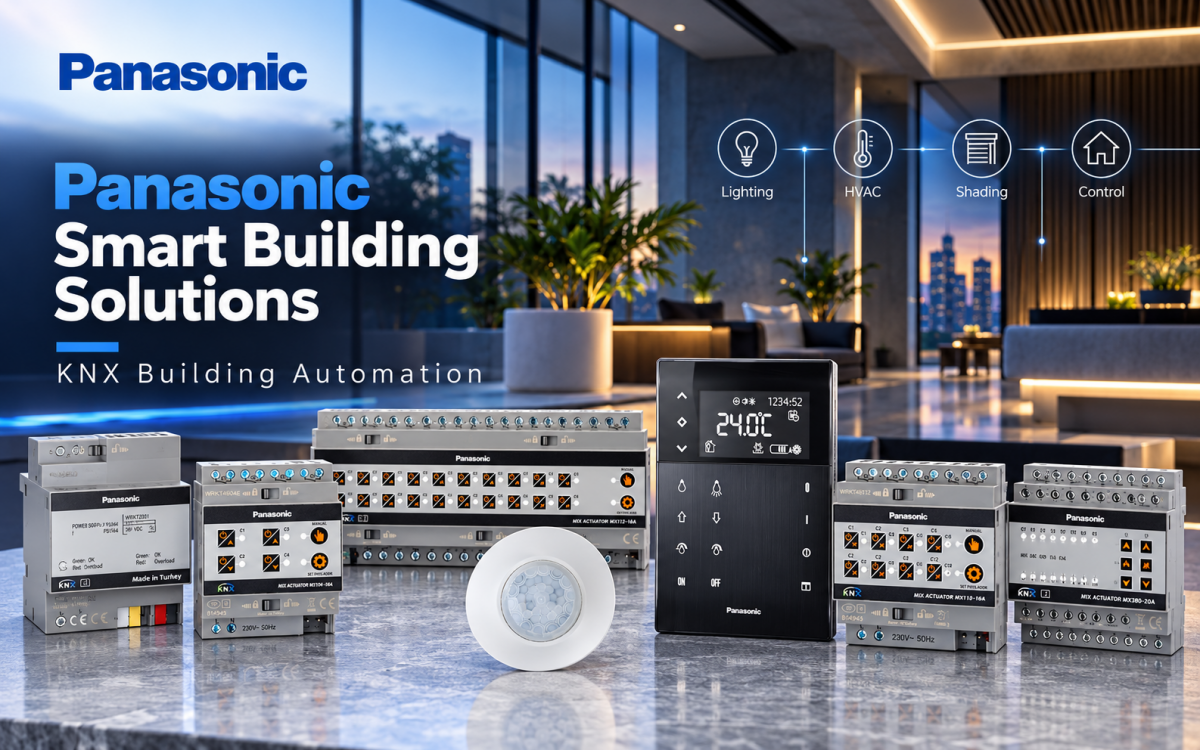
Discover Panasonic KNX automation switches, actuators, sensors, thermostats, DALI gateways, touch panels, and secure building control solutions.
Modern buildings demand intelligent electrical systems that combine comfort, energy efficiency, flexible control, and long-term operational reliability. From luxury residences to commercial offices, hotels, and large residential developments, smart building automation has become an essential part of modern electrical engineering.
Panasonic KNX building automation solutions offer an integrated approach to controlling lighting, shading, heating, cooling, and other building functions through the internationally recognized KNX standard.
Through Panasonic Electric Works Türkiye, the brand provides a comprehensive portfolio of KNX devices, including power supplies, switch and mixed actuators, automation switches, thermostats, presence sensors, communication interfaces, and advanced room-control products.
At KNXbazzar, we help KNX integrators, electrical contractors, system designers, and professional buyers explore Panasonic building automation equipment and select suitable products for their projects.
Explore Panasonic KNX Products at KNXbazzar →
1. About Panasonic: A Global Technology Brand with Electrical Engineering Expertise
Panasonic is a Japanese technology brand with a history extending back to 1918, when Konosuke Matsushita established the business that would eventually become one of the world’s recognized electrical and electronics companies.
Over the decades, Panasonic has developed products and technologies serving residential, commercial, and industrial applications.
Its activities encompass electrical infrastructure, electronic technologies, building equipment, energy-related systems, and solutions designed for connected environments.
In Türkiye, Panasonic Electric Works Türkiye provides a diverse electrical product portfolio that includes wiring devices, switches and sockets, electrical distribution equipment, lighting products, fire detection systems, and intelligent building automation solutions.
The company’s electrical installation portfolio also includes well-known VİKO-related product lines and architectural switch collections.
For building automation professionals, one of the most important areas of this portfolio is Panasonic KNX, a range of devices designed for interoperable smart building control.
These solutions combine electrical installation functionality with modern automation requirements, allowing multiple building systems to operate through a coordinated communication infrastructure.
2. What Is Panasonic KNX Building Automation?
Panasonic KNX is a building automation product portfolio based on the international KNX communication standard.
KNX enables compatible sensors, controllers, actuators, and communication devices to exchange information over a standardized building automation network.
Instead of managing lighting, climate control, blinds, and other functions through completely independent installations, KNX allows them to be coordinated through programmable automation logic.
Panasonic KNX products can support a wide range of functions:
- Lighting switching and dimming
- Motorized shutter and blind control
- Room temperature regulation
- Heating, ventilation, and air conditioning control
- Presence-based automation
- Lighting scene management
- Digital lighting integration through suitable DALI gateways
- Centralized electrical control
- Touch-panel and multifunctional room operation
- Secure KNX communication
- Building monitoring and integration
KNX systems are generally commissioned using ETS (Engineering Tool Software), the manufacturer-independent configuration platform for compatible KNX devices.
The open architecture makes it possible to combine suitable Panasonic KNX equipment with compatible products from other KNX manufacturers.
This flexibility is particularly important for professional automation projects, where multiple suppliers and specialized devices may be required.
3. Panasonic KNX Product Range
Panasonic Electric Works Türkiye offers KNX product families covering electrical distribution, input and output control, communication, user interfaces, and room automation.
The following sections explore the main product categories and their applications.
3.1 Panasonic KNX Power Supplies
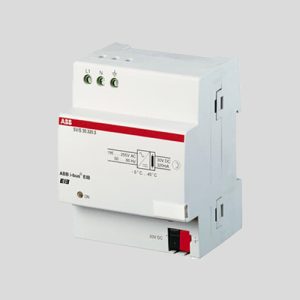
A properly designed KNX installation requires a reliable bus power supply.
Panasonic provides KNX power supplies for different installation sizes and current requirements.
Two notable products are:
Panasonic PS132 — 320 mA KNX Power Supply
The PS132 is designed to supply compatible KNX bus devices in installations requiring a 320 mA supply.
It is relevant for smaller KNX lines and applications where the connected devices’ total bus current consumption falls within the available power budget.
Panasonic PS164 — 640 mA KNX Power Supply
The PS164 is a higher-capacity KNX power supply for installations requiring a 640 mA bus supply.
The Panasonic PS164 product listed on KNXbazzar includes an additional unchoked 30 V DC output, making it important to distinguish between the KNX bus output and auxiliary output when designing a system.
Selecting a KNX power supply requires checking:
- Total current consumption of connected devices
- Power supply output capacity
- KNX line architecture
- Auxiliary power requirements
- Installation environment
- Applicable KNX topology limitations
Correct power supply sizing is essential for stable communication and reliable system operation.
Browse Panasonic KNX System Components →
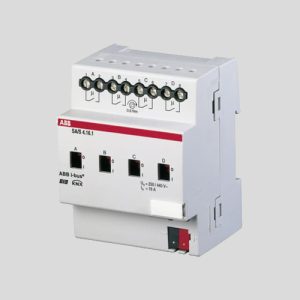
3.2 Panasonic KNX Switching Actuators
KNX switch actuators are central components of intelligent building installations.
They receive commands from the KNX network and control electrical loads through relay outputs.
Panasonic switching solutions are designed for applications involving:
- Lighting circuit switching
- Centralized lighting control
- Time-based switching
- Scene-based operation
- Electrical load control
- Integration with occupancy-related automation
Depending on the device, actuators may offer multiple output channels, local operation, status feedback, and configurable switching behavior.
For electrical distribution board design, engineers must evaluate the rated current, channel count, load type, and switching characteristics.
LED drivers, capacitive loads, and motors may have electrical characteristics that differ significantly from simple resistive loads.
Therefore, actuator selection should always be based on the manufacturer’s technical specifications rather than nominal current alone.
3.3 Panasonic KNX Secure Mixed Actuators
One of the notable areas of Panasonic’s current KNX portfolio is its range of mixed-function actuators.
Mixed actuators can simplify electrical panel design by providing multiple configurable automation outputs within one device.
An example available through KNXbazzar is:
Panasonic WRKT4824J5NC — Secure Mix Actuator, 24 Channel, 16 A
This product is associated with the MX324-16A-S model family.
It provides a high-channel-count solution for suitable building automation applications and includes KNX Secure functionality.
Mixed actuators are particularly relevant when projects require several switching or shading control circuits in the same electrical distribution panel.
Potential advantages include:
- Consolidating multiple control functions
- Simplifying equipment schedules
- Reducing the number of separate device types
- Supporting centralized panel organization
- Providing flexible KNX parameter configuration
The exact capabilities of each output must be confirmed through the applicable ETS database and product documentation.
KNX Secure functionality must also be commissioned correctly to deliver its intended communication security benefits.
3.4 Panasonic KNX Shutter and Blind Control
Automated shading contributes to comfort, privacy, daylight management, and building operation.
Panasonic KNX systems can control compatible motorized blinds, shutters, and curtains using appropriate actuator outputs.
Typical functions include:
- Open and close commands
- Up and down movement
- Stop commands
- Shading position control
- Scene-based operation
- Centralized shading management
- Integration with compatible sensors
For example, an office automation design may coordinate shading with lighting operation to improve visual comfort during periods of strong sunlight.
In residential buildings, occupants can activate predefined scenes that adjust lighting and blinds simultaneously.
Motor compatibility, control output characteristics, travel-time parameters, and interlocking requirements must be considered during system design.
3.5 Panasonic KNX DALI Gateways
Digital lighting control is an important part of modern commercial building automation.
DALI is a standardized communication system for compatible digital lighting equipment.
Panasonic provides KNX DALI gateway products, including:
DL101 — KNX DALI Gateway
DL102 — KNX DALI Gateway
These gateways are designed to connect supported DALI lighting systems with KNX building automation.
Depending on the selected gateway and connected equipment, KNX–DALI integration can support:
- Digital lighting commands
- Luminaire or group control
- Lighting dimming
- Scene management
- Coordination with KNX presence sensors
- Lighting control from wall switches and touch panels
- Supported lighting equipment status and monitoring
KNX DALI gateways are suitable for offices, hotels, retail buildings, conference centers, and educational facilities.
Before selecting a gateway, engineers should verify the supported DALI device types, address capacity, control features, firmware, and commissioning procedures.
The presence of a DALI gateway does not automatically guarantee compatibility with every DALI driver or advanced lighting function.
3.6 Panasonic KNX Automation Switches
Wall-mounted control devices form the primary interaction point between occupants and intelligent building systems.
Panasonic offers standard and modular KNX automation switches with different button configurations and design options.
The manufacturer’s portfolio includes:
- 1-gang automation switches
- 2-gang automation switches
- 3-gang automation switches
- 4-gang modular automation switches
- Multicolor indicator variants
- Selected models with integrated temperature sensing
- Compatible frames and switch covers
These products can be configured for different room-control functions, depending on the specific model.
Applications may include:
- Lighting switching
- Dimming commands
- Shading control
- Scene selection
- KNX value transmission
- Centralized control functions
For example, the Panasonic WRKT63335NC is a 3-gang, 3-module KNX modular push-button device with configurable RGB-related indication capabilities.
This type of product can be useful in commercial and residential projects where control functionality and visual consistency are both important.
Explore Panasonic KNX Switches →
3.7 Panasonic Multifunctional KNX Switches: MULTIS
Panasonic’s multifunctional automation switch category provides room-control solutions intended to combine multiple operating functions in a compact interface.
The MULTIS product family is part of Panasonic’s building automation portfolio.
Depending on the selected model, multifunctional switches can provide access to different KNX room-control functions through one wall-mounted interface.
These products are relevant for projects seeking to reduce the number of separate controls while maintaining convenient operation.
Potential applications include:
- Smart residential rooms
- Hotel guest rooms
- Office meeting rooms
- Executive workplaces
- Premium building interiors
Engineers should compare the physical design, supported control functions, ETS communication objects, and mounting requirements before choosing a specific MULTIS model.
3.8 Panasonic KNX Thermostats
Intelligent temperature management can improve indoor comfort and support efficient HVAC operation.
Panasonic offers KNX thermostats for integrated room climate control.
The official product range includes:
- KNX Standard Thermostat V2.0
- KNX Modular Thermostat
- KNX Thermostat BAU (Bus Access Unit)
Depending on the specific product and configuration, supported functions may include:
- Room temperature measurement
- Temperature setpoint adjustment
- Heating and cooling mode selection
- Fan speed commands
- HVAC operating mode changes
- KNX-based room climate coordination
Thermostats can be integrated with suitable HVAC controllers and actuators to implement room-level temperature control strategies.
For example, a KNX room thermostat may transmit temperature setpoints to a compatible fan coil controller.
Actual control functionality depends on the HVAC equipment, actuator selection, thermostat application program, and system configuration.
3.9 Panasonic KNX Presence and Environmental Sensors
Sensors enable building automation systems to react to real environmental conditions.
Panasonic provides multiple KNX presence and environmental sensing solutions.
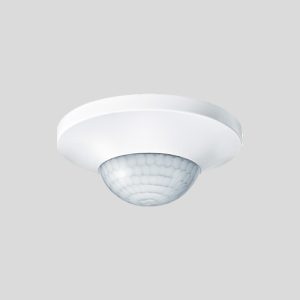
Panasonic A100 Presence Sensor
The A100 ceiling-mounted presence sensor is intended for compatible occupancy and brightness-related applications.
It can provide information for automated lighting control and related KNX functions.
Panasonic A100-T Presence Sensor
The A100-T extends the sensing concept by combining multiple environmental measurements.
The Panasonic WRKT32015NC A100-T listed at KNXbazzar integrates motion detection, ambient brightness, temperature, and humidity sensing.
Such multifunctional sensors can reduce the need for separate measurement devices in suitable applications.
Panasonic High-Bay Presence Sensors
Panasonic also provides presence sensing products intended for higher ceiling installations.
These devices can be relevant for warehouses, commercial buildings, and other spaces where standard detection patterns may be unsuitable.
Sensor selection should consider:
- Mounting height
- Detection coverage
- Occupancy requirements
- Environmental conditions
- Brightness measurement requirements
- Available KNX communication functions
Presence-based lighting control can reduce unnecessary operation when spaces are not occupied, although actual savings depend on the building’s use and programming.
3.10 Panasonic KNX Binary Input Modules
Binary input modules connect conventional electrical contacts and switches to a KNX automation network.
Panasonic offers compact and multi-channel input products.
Examples include:
IO100 — KNX Input Module
A multi-input product designed for compatible dry-contact integration applications.
IO101 — KNX Input Module
A model providing input configurations for supported dry-contact and mains-voltage sensing applications, subject to its electrical specifications.
KNX Binary Input 2-Way V2.0
A compact two-input module for connecting compatible potential-free contacts to KNX.
The manufacturer also lists 4-way and 6-way binary input versions.
These interfaces can support:
- Conventional push-button integration
- Contact monitoring
- Scene triggering
- Lighting control commands
- Shading commands
- Selected technical signal integration
Binary input modules are particularly useful when an automation project must incorporate existing switches or external contact-based devices.
3.11 Panasonic KNX I/O and Room Control Modules
Some building automation projects require large numbers of inputs and outputs within a coordinated electrical system.
Panasonic provides specialized I/O products, including:
IO200-S — KNX Secure I/O Module
The IO200-S is listed with 22 dry-contact inputs, 2 voltage inputs, and 14 relay outputs.
This type of high-density device can be relevant to projects requiring extensive input monitoring and switching control.
Panasonic’s portfolio also includes room-controller products for integrated room automation applications.
These solutions are particularly relevant for hospitality and multi-room buildings, where multiple room functions must operate through a consistent control architecture.
Device selection should be based on the available inputs and outputs, electrical ratings, application software, and required communication functions.
3.12 Panasonic KNX IP Interfaces, Routers, and Line Couplers
Professional KNX installations often require multiple lines, IP connectivity, and system-level communication management.
Panasonic provides network infrastructure devices, including:
- KNX Secure IP Interface
- KNX Secure IP Router
- KNX Secure Area/Line Coupler
- KNX USB Gateway TP
- KNX USB Gateway Type-C
- Conventional KNX area/line coupling devices
These devices serve different purposes.
KNX IP Interfaces allow supported communication between a KNX installation and engineering tools or compatible IP applications.
KNX IP Routers support appropriate KNXnet/IP communication and routing functions.
KNX Line Couplers connect selected KNX lines or areas while providing the required communication and line-separation functions.
KNX USB Interfaces enable direct communication between compatible engineering equipment and a KNX installation.
A product available on KNXbazzar is the Panasonic WRKT21015NC KNX Area/Line Coupler TP.
Correct network addressing, topology design, ETS configuration, and protocol settings are necessary for stable operation.
3.13 Panasonic KNX Secure Technology
Security is becoming increasingly important in network-connected buildings.
Panasonic’s KNX portfolio includes devices that support KNX Secure functionality.
KNX Secure provides standardized security mechanisms for supported KNX communications.
Depending on the equipment and technology used, these mechanisms can help protect communication integrity, authenticity, and confidentiality.
Panasonic Secure product categories include:
- Secure IP interfaces
- Secure IP routers
- Secure line couplers
- Secure I/O modules
- Selected secure actuators
The availability of KNX Secure does not mean that a system is automatically protected.
Secure operation requires correctly selected compatible devices, suitable ETS configuration, security key management, and appropriate network design.
For commercial buildings and projects with security requirements, these factors should be included in the engineering specification.
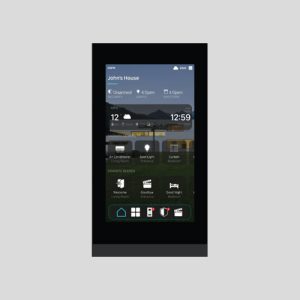
3.14 Panasonic KNX Touch Panels
Touch panels provide centralized access to building automation functions through a graphical user interface.
Panasonic’s building automation portfolio includes touchscreen solutions for modern room control.
Depending on the product and integration architecture, a touch panel may provide access to:
- Lighting control
- Shading operation
- Temperature settings
- Scene activation
- Room status information
- Additional supported KNX functions
Touch panels are relevant for residential developments, premium villas, hotels, executive offices, and meeting rooms.
When selecting a panel, engineers should verify the required communication interfaces, available visualization functions, installation dimensions, power requirements, and configuration method.
3.15 Panasonic KNX Hotel Automation Solutions
Hotel automation requires coordinated operation of multiple room systems while maintaining comfort and intuitive guest interaction.
Panasonic’s portfolio includes hotel-related automation equipment and room-control products.
Depending on the selected system architecture, a KNX hotel room design can integrate:
- Guest room lighting
- Heating and cooling control
- Centralized room scenes
- Curtain and shading operation
- Guest room status inputs
- Occupancy-related control strategies
- Compatible hotel management interfaces
For hospitality projects, the correct combination of switches, thermostats, room controllers, input modules, actuators, and interfaces is essential.
Integration with a hotel property management system or other external software requires suitable supported gateways and project-specific engineering.
4. Panasonic KNX Applications
Smart Homes and Luxury Villas
Panasonic KNX solutions can support intelligent lighting, curtains, climate control, and personalized scenes.
A homeowner might use a single room control to activate an evening scene that adjusts compatible lighting circuits and motorized shading.
Residential Apartments and Developments
Standardized KNX designs allow developers to implement consistent automation functions across multiple apartments.
Modular switches and conventional wiring accessory families can also help create coordinated interior design schemes.
Hotels and Hospitality Buildings
Hotels can use KNX room controllers, thermostats, automation switches, and actuators for integrated room operation.
The final architecture depends on hotel requirements and the available third-party integrations.
Offices and Commercial Buildings
Panasonic KNX devices can support occupancy-based lighting, room temperature management, shading control, and centralized electrical operation.
Retail and Educational Buildings
DALI gateways, sensors, and KNX switching components can be combined to implement suitable lighting and automation strategies in shops, classrooms, and common areas.
5. Why Choose Panasonic KNX for Building Automation?
Panasonic’s KNX portfolio offers several characteristics relevant to professional projects.
Established electrical technology portfolio
Panasonic Electric Works Türkiye provides electrical infrastructure and building automation products under an established global brand.
Open-standard communication
KNX allows compatible products from different manufacturers to communicate within the same installation.
Extensive control product categories
The portfolio covers power supplies, actuators, sensors, switches, thermostats, I/O modules, gateways, and system interfaces.
Architectural integration
Panasonic’s electrical wiring accessory experience complements its modular wall-control product ranges.
Support for secure automation
Selected devices include KNX Secure capabilities for projects requiring protected communication.
Scalable installation design
Properly engineered KNX solutions can be used in small residential projects and larger commercial developments.
Engineering flexibility
ETS enables system integrators to customize compatible device parameters and communication functions.
6. Panasonic KNX vs. Conventional Electrical Installations
| Feature | Conventional Installation | Panasonic KNX Installation |
|---|---|---|
| Lighting control | Mostly independent switches | Local, centralized, and programmable |
| Dimming | Dedicated dimmer controls | Integrated through compatible KNX devices |
| Shading | Separate motor controls | Coordinated KNX shading control |
| Room climate | Independent thermostats | Integrated KNX temperature management |
| Sensors | Often separate systems | Combined building automation functions |
| Control flexibility | Frequently requires physical modification | Many functions can be modified in ETS |
| Integration | Project-specific interfaces | KNX interoperability and suitable gateways |
| System expansion | Depends on conventional wiring | Expandable through appropriate KNX design |
KNX installations may require greater initial engineering and equipment investment.
However, they can offer advantages in functional flexibility, centralized management, and long-term adaptability.
7. How to Select the Right Panasonic KNX Products
Choosing the correct KNX devices requires a systematic engineering approach.
Before preparing a product purchase list, consider the following criteria:
- Building type: Identify whether the installation is residential, commercial, hospitality, or another application.
- Control functions: Define switching, dimming, shading, temperature, and monitoring requirements.
- Input/output capacity: Calculate the number and type of required channels.
- Electrical characteristics: Review current ratings, load types, voltage requirements, and installation conditions.
- KNX topology: Design bus lines, power supply capacity, routing, and coupling arrangements.
- Communication compatibility: Verify KNX, DALI, IP, and other necessary integration requirements.
- Security requirements: Select appropriate KNX Secure devices where required.
- ETS applications: Confirm supported device databases, firmware, and application functionality.
- Manufacturer references: Check the exact Panasonic model and product code.
- Future expansion: Allow for additional devices and project modifications.
For example, an engineer choosing a 24-channel mixed actuator should verify the number of channels required for switching and shading, the supported output configuration, and the actual connected loads.
Similarly, power supplies must be selected according to current requirements rather than simply choosing the highest available current rating.
8. Panasonic KNX Product Catalog 2026
The Panasonic KNX Building Automation Catalog 2026 is a valuable reference for engineers, system integrators, electrical contractors, and procurement professionals.
The manufacturer’s catalog covers major product categories, including:
- KNX Power Supplies
- KNX Actuators
- Input Modules
- KNX Gateways
- Automation Switches
- Thermostats
- Switch Frames and Covers
- MULTIS Multifunctional Automation Switches
- KNX Sensors
- KNX System Devices
- Touch Panels
- Room Controllers
For product selection and technical documentation, visit the KNXbazzar Download Center:
Panasonic KNX Catalogs and Downloads — KNXbazzar →
You can also access Panasonic’s official technical resources and catalog information through:
Panasonic Electric Works Türkiye — Building Automation Systems →
Official Panasonic KNX Catalog 2026 (PDF) →
Always verify the current datasheet and manufacturer product reference before finalizing an equipment schedule.
9. Explore Panasonic KNX Products at KNXbazzar
KNXbazzar is a specialized online platform for KNX building automation equipment and smart building technologies.
The Panasonic brand collection provides access to listed products for professional installations.
Engineers and buyers can explore Panasonic devices such as:
- PS132 and PS164 KNX power supplies
- KNX line couplers
- Secure mixed actuators
- A100-T multifunctional presence sensors
- Modular KNX wall switches
- Other available Panasonic automation components
Product availability, pricing, and specifications should be checked on the individual product pages.
Whether you are preparing a new residential project, upgrading a commercial installation, or designing an integrated hotel automation system, selecting the correct KNX equipment is an important step toward reliable operation.
Browse All Panasonic KNX Products →
Visit the KNXbazzar Download Center →
10. Frequently Asked Questions About Panasonic KNX
What is Panasonic KNX?
Panasonic KNX is a portfolio of building automation products that use the internationally recognized KNX standard for controlling compatible lighting, shading, HVAC, and other building functions.
Does Panasonic manufacture KNX devices?
Panasonic Electric Works Türkiye markets a range of KNX building automation products, including power supplies, actuators, switches, thermostats, sensors, and communication devices.
Is Panasonic KNX compatible with ABB and Schneider Electric KNX?
Compatible KNX-certified products can communicate within the same appropriately designed KNX installation. Individual device functions and communication objects must still be verified.
Does Panasonic offer KNX Secure products?
Yes. Selected Panasonic KNX devices support KNX Secure functionality, including certain interfaces, routers, couplers, and actuators.
Does Panasonic provide KNX DALI gateways?
Yes. The Panasonic building automation portfolio includes DL101 and DL102 KNX DALI gateway models for compatible digital lighting integration.
Can Panasonic KNX control air conditioning?
Panasonic KNX thermostats and suitable control devices can participate in HVAC automation. The exact equipment interface and supported functions depend on the selected HVAC system and integration architecture.
What is the Panasonic A100-T sensor?
The A100-T is a KNX presence sensor providing movement, brightness, temperature, and humidity-related measurement functionality.
What is the difference between PS132 and PS164?
The PS132 is a 320 mA KNX power supply, while the PS164 provides 640 mA bus supply capacity. The correct choice depends on the KNX line’s calculated power requirements and the device specifications.
What software is used to program Panasonic KNX devices?
Compatible Panasonic KNX devices are configured using ETS, together with the appropriate manufacturer product database and application program.
Where can I download the Panasonic KNX catalog?
Visit the KNXbazzar Download Center for available documentation, or use Panasonic Electric Works Türkiye’s official catalog resources.
Where can I buy Panasonic KNX products?
Visit the Panasonic brand page on KNXbazzar to review listed products, specifications, and purchasing options.
Conclusion: Intelligent Building Automation with Panasonic KNX
Panasonic KNX building automation solutions combine standardized communication, flexible engineering, and a broad range of intelligent electrical control products.
From KNX power supplies and mixed actuators to modular switches, presence sensors, DALI gateways, thermostats, and secure network interfaces, Panasonic offers components for various residential, commercial, and hospitality applications.
The flexibility of the KNX standard also allows suitably compatible devices to be integrated with equipment from other manufacturers, supporting scalable and adaptable building automation designs.
For professional engineers and system integrators, successful implementation begins with accurate product selection, reliable electrical design, and correct ETS commissioning.
Explore Panasonic’s KNX product range at KNXbazzar and find suitable technologies for your next intelligent building project.