
ABB Smart Building Solutions: Complete Guide to ABB i-bus® KNX Products and Building Automation
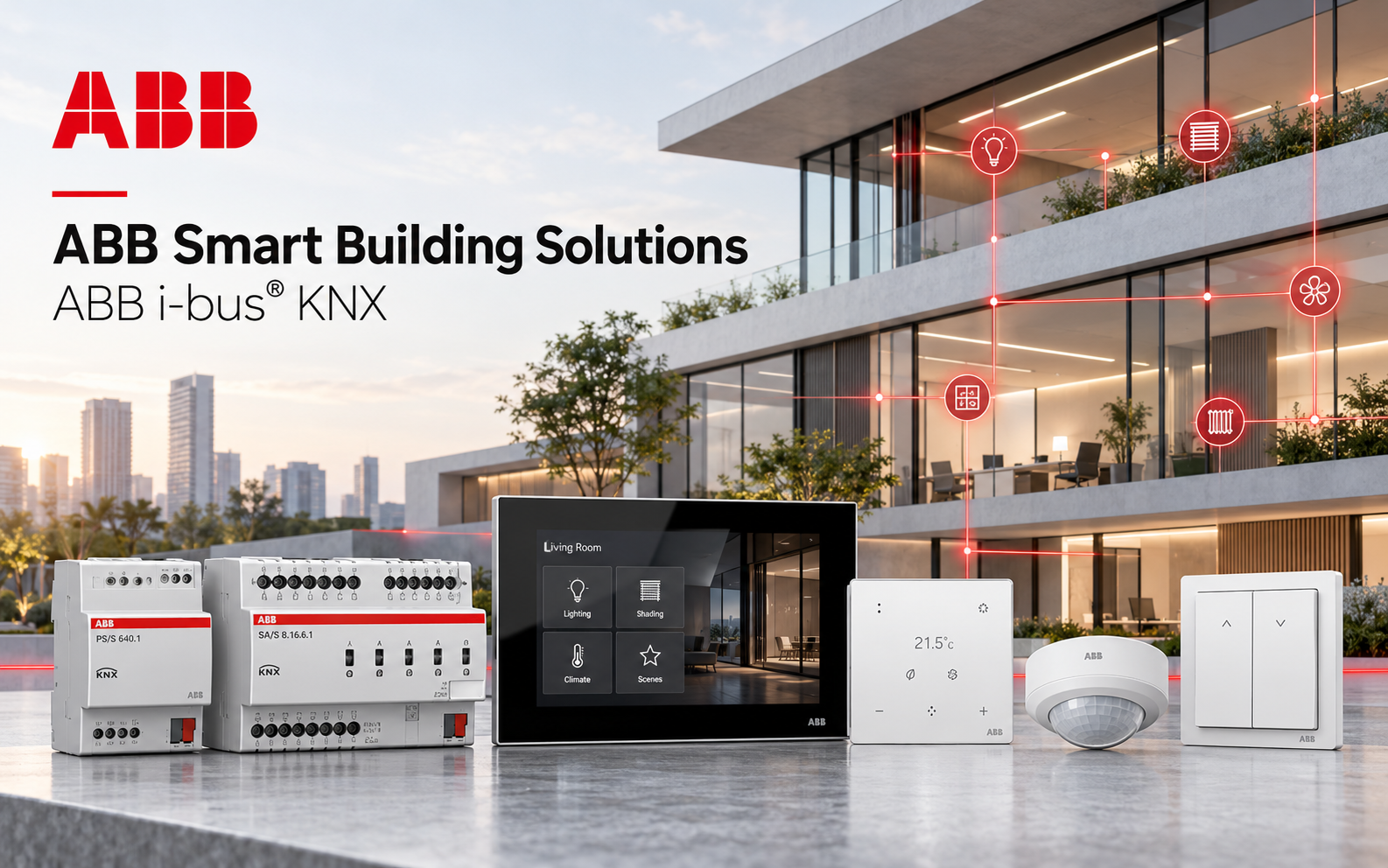
Engineering Intelligent Buildings with ABB KNX Technology
Modern buildings demand more than conventional electrical installations. Energy efficiency, intelligent lighting, automated climate control, security, and seamless integration are now essential components of residential and commercial environments.
ABB, a global technology leader in electrification and automation, addresses these requirements through its comprehensive ABB i-bus® KNX product portfolio.
From intelligent homes and luxury hotels to commercial offices, hospitals, and large-scale developments, ABB KNX solutions enable flexible, scalable, and integrated building automation.
At KNXbazzar, we help engineers, system integrators, electrical contractors, and professional buyers discover and source ABB smart building products for their automation projects.
Explore ABB KNX Products at KNXbazzar →
1. About ABB: A Global Leader in Electrification and Automation
ABB has a long history of technological innovation. The company was established in 1988 through the merger of Sweden’s ASEA and Switzerland’s Brown Boveri (BBC), bringing together two major electrical engineering organizations with histories extending back to the nineteenth century.
Headquartered in Switzerland, ABB develops technologies that improve the efficiency, productivity, and sustainability of electrical and automation systems.
Its expertise encompasses electrical infrastructure, industrial automation, energy management, and intelligent building technologies.
Within the building automation sector, ABB offers an extensive range of solutions designed to connect lighting, shading, heating, ventilation, security, and electrical systems into a coordinated infrastructure.
One of its most important product families is ABB i-bus® KNX, developed for professional building automation based on the international KNX standard.
2. What Is ABB i-bus® KNX?
ABB i-bus® KNX is a comprehensive building automation system based on KNX, an open, manufacturer-independent communication standard used to control electrical and mechanical functions within intelligent buildings.
Unlike conventional installations, where lighting, heating, and other functions may operate independently, a KNX installation allows compatible devices to exchange information and respond to predefined automation scenarios.
ABB KNX systems can integrate:
- Lighting and dimming control
- Motorized blinds, shutters, and curtains
- Heating, ventilation, and air conditioning (HVAC)
- Room temperature management
- Occupancy and presence detection
- Electrical energy monitoring
- Security and technical alarm integration
- Touch panels and room controllers
- Time-based and logic-based automation
- Integration with compatible third-party systems
KNX installations commonly use twisted-pair bus communication, with additional possibilities for IP-based connectivity and compatible KNX RF solutions.
System configuration and commissioning are performed using the ETS (Engineering Tool Software) platform, allowing qualified professionals to design and program interoperable KNX installations.
This architecture makes ABB KNX suitable for new construction, building modernization, and complex projects requiring long-term operational flexibility.
3. ABB KNX Product Range: Intelligent Control for Every Building
ABB offers a broad portfolio of KNX devices that support automation from the electrical distribution panel to the final room-control interface.
3.1 ABB KNX Switch Actuators
ABB KNX switch actuators are fundamental components of intelligent electrical installations.
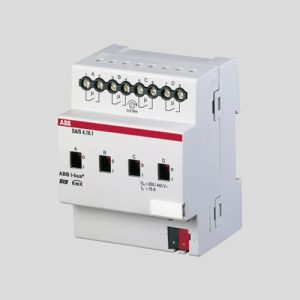
Installed primarily inside electrical distribution boards, these devices allow KNX commands to control connected electrical loads through individually configurable relay outputs.
Typical applications include:
- Switching lighting circuits
- Controlling electrical equipment
- Scheduling connected loads
- Implementing centralized OFF commands
- Operating selected loads using occupancy information
- Executing programmed scenes and logic functions
ABB offers switch actuators with different channel counts, current ratings, and functional capabilities.
ABB SA/S and SAH/S product families are relevant for engineers and integrators selecting switching solutions for residential and commercial projects.
Depending on the exact model, available functions may include manual output operation, status feedback, configurable switching logic, current detection, or combined switching and shutter control.
Choosing the correct actuator requires evaluating the electrical load, number of outputs, contact rating, installation requirements, and ETS application functionality.
3.2 ABB KNX Dimming Actuators and Lighting Control
Lighting control is one of the most widely used applications of KNX technology.
ABB provides lighting automation solutions for simple switching, brightness adjustment, scene management, and advanced digital lighting control.
Depending on the product and installation requirements, ABB lighting solutions may support universal dimming, 1–10 V control, or integration with DALI lighting systems.
With the appropriate devices, an intelligent lighting installation can provide:
- Adjustable illumination levels
- Preset lighting scenes
- Occupancy-based lighting control
- Time-dependent lighting schedules
- Daylight-related lighting management
- Centralized lighting operation
ABB KNX dimming devices are particularly useful in hospitality, premium residential, conference-room, and commercial lighting applications.
Compatibility between dimmers, LED drivers, lamps, and connected loads must always be verified before installation.
3.3 ABB KNX DALI Gateways
DALI is an established digital communication protocol for lighting control.
ABB KNX DALI gateways connect compatible DALI lighting equipment with a KNX building automation installation.
This integration enables lighting designers and automation engineers to coordinate digital luminaires with other building functions.
Depending on the selected gateway and supported DALI devices, possible applications include:
- Individual or group luminaire control
- Lighting scene management
- Dimming and status monitoring
- Integration with presence sensors
- Constant-light control
- Tunable-white lighting with supported products
- Monitoring supported lighting equipment and fault conditions
ABB offers multiple DALI gateway variants for different project requirements.
These products are valuable in office buildings, hotels, retail developments, educational facilities, and other projects that require professional lighting management.
Explore ABB Building Automation Products →
3.4 ABB KNX Shutter and Blind Actuators
Motorized shading systems contribute to comfort, privacy, daylight management, and thermal performance.
ABB KNX shutter and blind actuators are designed to control compatible motorized blinds, shutters, and shading equipment.
Depending on the device and control strategy, features can include:
- Opening and closing control
- Blind position management
- Slat adjustment
- Centralized shading commands
- Sun-position-related automation
- Weather-dependent protection functions
- Coordination with heating and cooling systems
For example, an intelligently controlled building can adjust selected shading devices according to sunlight conditions to reduce glare and manage solar heat gain.
ABB also offers specialized shading solutions for projects requiring additional automation functionality.
3.5 ABB KNX HVAC and Climate Control
Heating, ventilation, and air conditioning represent a significant part of building energy demand.
ABB addresses climate automation through KNX-compatible thermostats, fan coil controllers, valve actuators, room controllers, and specialized HVAC products.
The ABB ClimaECO concept brings together compatible KNX components to support integrated room and building climate control.
Typical functions include:
- Individual room temperature regulation
- Heating and cooling setpoint control
- Fan coil unit operation
- Fan speed management
- Valve actuator control
- Scheduled temperature operation
- Occupancy-dependent comfort modes
- Coordination between shading and HVAC
Intelligent climate control can improve comfort while avoiding unnecessary operation when spaces are unoccupied.
ABB KNX HVAC products are particularly relevant for hotels, offices, apartment buildings, and developments with independent room climate requirements.
The exact control functions depend on the selected equipment, HVAC architecture, and commissioning design.
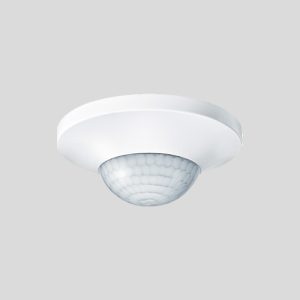
3.6 ABB KNX Sensors and Presence Detectors
Sensors allow an intelligent building to respond to changes in its environment.
ABB provides compatible devices for detecting occupancy, motion, environmental conditions, and user interaction.
Depending on the selected product, measurements and inputs may include:
- Presence and movement
- Ambient brightness
- Room temperature
- Relative humidity
- Carbon dioxide concentration
- External weather conditions
- Conventional electrical contact signals
Presence detectors can contribute to energy-efficient operation by controlling lighting according to actual occupancy.
Temperature and environmental sensors can also provide information to the KNX HVAC system, supporting more responsive indoor climate management.
For large commercial projects, selecting the correct detection coverage, mounting height, sensor type, and control logic is essential.
3.7 ABB KNX Touch Panels and Smart Room Controllers
Modern building automation combines sophisticated engineering with intuitive user interfaces.
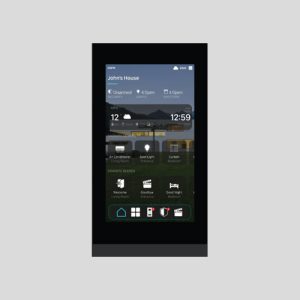
ABB offers an extensive selection of switches, keypads, room-control devices, and touchscreen interfaces.
Notable product families include:
ABB RoomTouch®
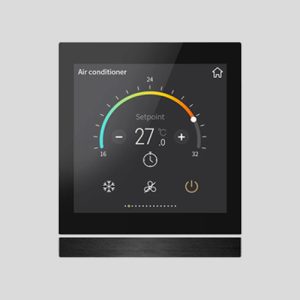
RoomTouch provides touch-based room operation for compatible KNX installations, allowing multiple room functions to be managed through an elegant interface.
ABB SmartTouch®
The ABB SmartTouch range includes advanced touch panels that combine smart building functions with additional compatible control and communication capabilities.
ABB Trevion®
ABB Trevion combines flexible room-control functionality with contemporary design, supporting intuitive operation through compatible sensor and control elements.
Depending on the selected device, possible functions include lighting scenes, temperature adjustments, shading control, and visualization of building information.
These solutions are especially suitable for premium residential installations, hotels, meeting rooms, executive offices, and architectural projects where visual design and functionality are equally important.
3.8 ABB KNX Power Supplies and System Components
A reliable KNX installation requires properly designed system infrastructure.
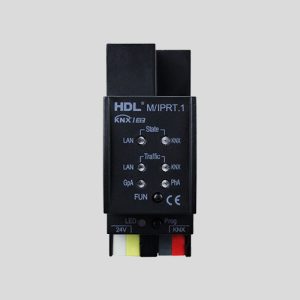
ABB offers a range of KNX power supplies, line couplers, interfaces, and other installation components.
The main categories include:
- KNX bus power supplies
- KNX IP interfaces
- KNX IP routers
- KNX line couplers
- KNX USB interfaces
- Bus connection components
- System accessories
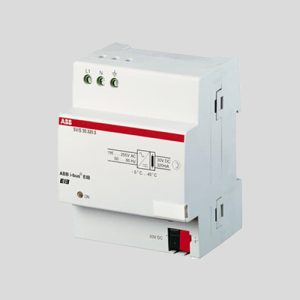
KNX bus power supplies provide the required supply for compatible bus devices, while communication interfaces support programming and connectivity.
IP routers and line couplers help organize communication between KNX lines, areas, and IP infrastructure.
Correct power supply sizing, KNX topology design, and network configuration are essential for stable system operation.
3.9 ABB KNX Energy Management Solutions
Monitoring and optimizing electricity consumption are increasingly important in modern buildings.
ABB offers KNX-compatible energy management components that can help building operators measure, visualize, and respond to electrical consumption data.
Depending on the installed devices, these solutions may support:
- Electrical energy measurement
- Monitoring selected electrical loads
- Consumption data collection
- Status and measurement visualization
- Energy-dependent control strategies
- Integration with building management systems
By combining energy information with lighting, HVAC, and shading automation, system integrators can implement more informed operating strategies.
Actual energy savings depend on building characteristics, equipment, occupancy patterns, and the quality of system configuration.
3.10 ABB KNX Gateways and System Integration
Intelligent buildings frequently contain equipment communicating through different protocols.
ABB’s building automation portfolio includes interfaces and gateways designed to connect supported systems and simplify integration.
Depending on the specific product, integration may involve:
- KNXnet/IP
- DALI
- Modbus
- BACnet-compatible building management interfaces
- Digital and analog inputs or outputs
A gateway should always be selected according to the required protocol version, supported data points, physical interface, and project requirements.
Not every ABB KNX device supports every protocol directly. Integration capabilities must be verified against the selected gateway’s technical documentation.
4. ABB KNX Applications in Residential and Commercial Buildings
ABB i-bus® KNX can be used across a wide variety of building types.
Smart Homes and Luxury Villas
ABB KNX systems enable homeowners to manage lighting, shading, climate control, and other connected functions through coordinated automation.
Typical scenarios include welcome-home lighting, nighttime operating modes, automated shading, and centralized control.
Hotels and Hospitality
Hotels can use KNX technology for room lighting, guest comfort, climate management, and selected energy-saving strategies.
In combination with appropriately selected controllers and interfaces, room functions can be integrated into a broader hotel automation strategy.
Offices and Commercial Buildings
ABB KNX supports lighting management, occupancy-based control, shading automation, and climate coordination in professional working environments.
The result is a building infrastructure that can be adjusted to changing operational needs.
Hospitals and Healthcare Facilities
Suitable building automation functions can help manage lighting, environmental comfort, and selected monitoring applications in healthcare buildings.
Safety-critical and regulated healthcare functions require independently compliant systems and project-specific engineering.
Educational and Public Buildings
Schools, universities, administrative facilities, and public buildings may benefit from centralized schedules, lighting control, and energy monitoring.
5. Why Choose ABB for KNX Building Automation?
ABB is an established choice for professional automation projects because its portfolio addresses a broad range of building control requirements.
Comprehensive product ecosystem
ABB provides infrastructure components, actuators, sensors, HVAC products, gateways, and user interfaces.
Open-standard integration
ABB i-bus® KNX is built around KNX technology, allowing appropriately certified and compatible products from different manufacturers to operate within the same system.
Scalable architecture
KNX can support individual rooms, complete homes, and complex commercial buildings when appropriately engineered.
Engineering flexibility
ETS configuration enables professional integrators to customize device behavior, communication objects, and building automation logic.
Energy-conscious operation
Lighting schedules, occupancy detection, shading coordination, and HVAC control can contribute to more efficient building operation.
Architectural design options
ABB’s room-control and touchscreen product families give designers options for combining appearance with functionality.
6. ABB KNX vs. Conventional Electrical Installations
Conventional electrical systems often rely on separate circuits and independent control devices.
ABB KNX installations introduce a communication layer through which compatible equipment can exchange information.
| Feature | Conventional Installation | ABB KNX Installation |
|---|---|---|
| Lighting operation | Mainly local switching | Local, centralized, and automated control |
| Lighting scenes | Additional dedicated equipment | Configurable through compatible KNX devices |
| Shading automation | Often independent | Integrated with other building functions |
| Climate coordination | Frequently separate controls | Compatible KNX HVAC integration |
| Monitoring | Depends on additional equipment | Integrated through suitable KNX components |
| Functional changes | May require rewiring | Many changes can be made through reprogramming |
| Multi-system integration | Project-specific interfaces | KNX and suitable protocol gateways |
Although KNX installations may require greater initial engineering and equipment investment, they can offer operational flexibility and integration advantages over the life of a building.
7. How to Select the Right ABB KNX Products
Selecting automation equipment should begin with the project requirements rather than individual product prices.
Before ordering ABB KNX components, engineers and procurement professionals should evaluate:
- Application requirements: Identify the lighting, shading, HVAC, monitoring, and control functions.
- Device capacity: Select the appropriate channels, rated currents, outputs, and electrical characteristics.
- Communication compatibility: Verify KNX, DALI, IP, Modbus, or other necessary integration interfaces.
- Installation design: Review DIN-rail space, bus topology, power supply capacity, and wiring requirements.
- Software support: Confirm ETS application availability and applicable firmware requirements.
- Future expansion: Consider additional devices, system lines, and functional flexibility.
- Technical documentation: Verify product codes, manufacturer data, and supported functions before purchasing.
For professional projects, accurate product identification is particularly important.
ABB devices may have similar model names but different channel counts, electrical ratings, or application capabilities.
Using the complete ABB manufacturer part number helps avoid purchasing incompatible equipment.
8. ABB KNX Catalog Download and Technical Documentation
Technical documentation is essential for selecting, designing, and commissioning professional KNX systems.
The ABB i-bus® KNX Product Range Overview 2025/2026 provides an organized introduction to ABB’s building automation portfolio.
Engineers and system integrators can use the catalog to review available product families, application categories, and technical product information.
Visit the KNXbazzar Download Center to access the ABB catalog and other available manufacturer documents.
Download ABB i-bus® KNX Catalog 2025/2026 →
Additional manufacturer documentation, product application files, and engineering resources are available through the official ABB i-bus® KNX website.
9. Explore ABB KNX Products at KNXbazzar
KNXbazzar is a specialized platform for smart building and KNX automation products, supporting professional buyers, contractors, and system integrators.
Our ABB product listings help visitors identify relevant KNX devices, compare available models, and review product-specific information.
Whether your project requires KNX switch actuators, DALI gateways, lighting controllers, power supplies, HVAC components, or advanced room-control devices, the ABB brand collection is a practical starting point.
Explore the ABB portfolio and find suitable products for your next building automation project.
Visit KNXbazzar Download Center →
10. Frequently Asked Questions About ABB KNX
What is ABB i-bus® KNX?
ABB i-bus® KNX is a building automation product range based on the international KNX communication standard. It enables integrated control of compatible lighting, shading, HVAC, and other building functions.
Is ABB KNX suitable for residential buildings?
Yes. ABB KNX solutions can be used in apartments, luxury homes, villas, and larger residential developments. Product selection depends on the scale and functional requirements of the installation.
Can ABB KNX work with devices from other manufacturers?
Yes. KNX is an open, manufacturer-independent standard. Compatible devices from different manufacturers can communicate within a correctly designed KNX installation. Individual functions and integration requirements must still be verified.
Does ABB KNX support DALI lighting systems?
Yes. ABB provides KNX DALI gateways for integrating supported DALI lighting equipment with KNX building automation.
Can ABB KNX control HVAC systems?
Yes. ABB offers KNX-compatible thermostats, fan coil controllers, valve control devices, and HVAC integration solutions. Compatibility depends on the controlled equipment and system architecture.
Which software is used to program ABB KNX devices?
ABB KNX devices are generally configured and commissioned using ETS, the manufacturer-independent Engineering Tool Software for KNX.
Where can I download the ABB KNX catalog?
You can find the ABB i-bus® KNX Product Range Overview 2025/2026 through the KNXbazzar Download Center.
Where can I find ABB KNX products online?
Visit the ABB brand page on KNXbazzar to explore listed ABB building automation products.
Conclusion: Building Smarter with ABB KNX
ABB i-bus® KNX brings together intelligent control, engineering flexibility, and an extensive product ecosystem for modern building automation.
From switching and dimming actuators to sophisticated HVAC control, lighting gateways, sensors, and touchscreen interfaces, ABB offers solutions for a diverse range of residential and commercial applications.
For engineers, system integrators, and project buyers, selecting properly matched KNX components is essential for building reliable and expandable automation systems.
Explore the ABB product portfolio at KNXbazzar, review available technical documentation, and select the right solutions for your next intelligent building project.