Selecting Schneider SpaceLogic KNX Actuators by Load and Channel Requirements
Compare Schneider SpaceLogic KNX switching actuators by channel count, switching rating and master, extension or hybrid architecture.
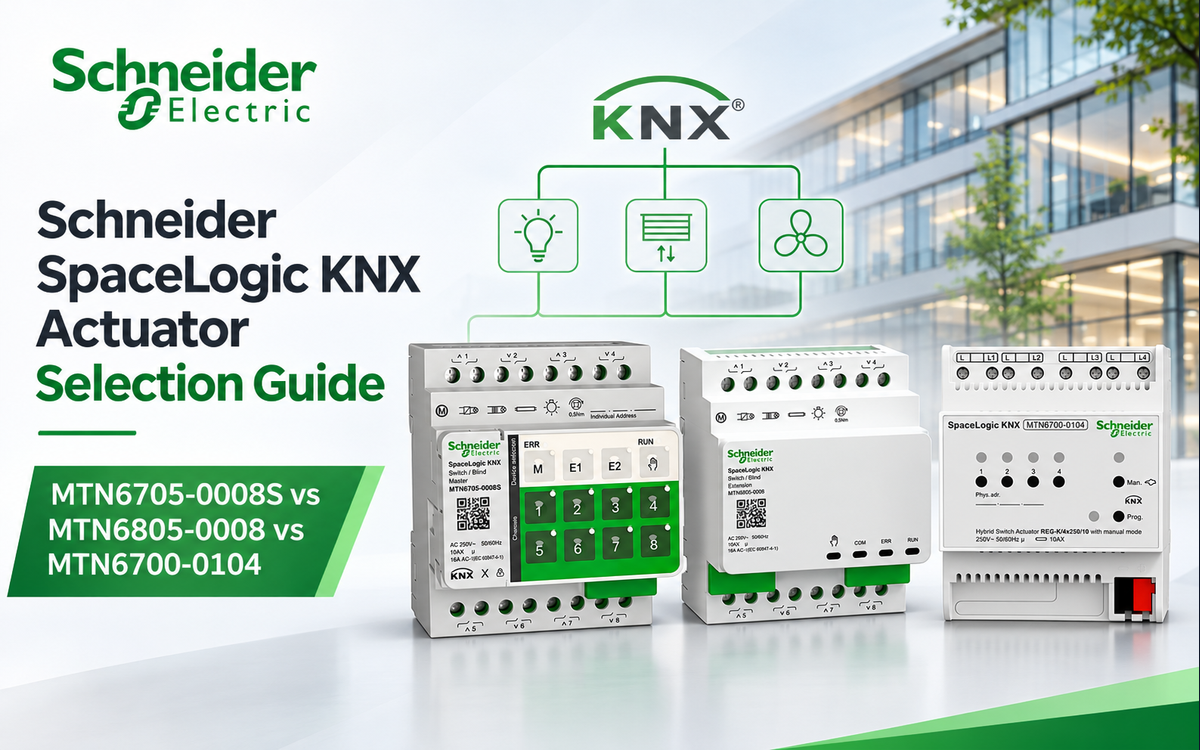
Selecting a SpaceLogic KNX actuator starts with two practical questions: how many separately controlled loads does the distribution board serve, and what switching category is appropriate for each load? Schneider Electric offers several channel densities and two distinct actuator architectures. A master/extension arrangement serves configurable switch and blind outputs, while the SpaceLogic hybrid switching range offers dedicated variants at 10 A and 20 A class designations. Correct selection is about matching the circuit schedule to a documented actuator reference, rather than selecting the highest channel count by default.
This guide covers nine Schneider models available through KNXbazzar. It distinguishes channel quantity, published switching designation and device role, then explains how to translate those differences into an electrical panel schedule. Explore the broader Schneider KNX products range or browse Switching Actuators alongside this model-by-model selection.
Begin with the circuit schedule, not the number of lighting fixtures
A switching channel represents a controlled output circuit. Several luminaires wired to one switched circuit may consume one actuator output, while independently controlled groups need separate outputs. Count switched circuits, motor-control groups and any independent operating requirements before allocating hardware. Separate the need for straightforward on/off switching from the requirement for coordinated blind movement, and make that distinction visible on the schematic.
For the bill of materials, record the actual load category, operating current, intended switching duty and protective device for each output. A nominal current designation alone cannot substitute for the manufacturer’s applicable load-specific switching conditions. In LED lighting projects, for example, driver inrush and the number of drivers switched together can be more important than a simple sum of running watts.
Schneider SpaceLogic KNX actuator models at a glance
The following matrix uses model-specific Schneider Electric product identification for channel counts and published switching designations. The master and extension references belong to a different configuration approach from the hybrid switching references.
| Schneider model | Output channels | Published switching designation | Device role |
|---|---|---|---|
| MTN6705-0008S | 8 | 10AX/16AC1 | Secure switch/blind master |
| MTN6805-0008 | 8 | 10AX/16AC1 | Switch/blind extension |
| MTN6700-0104 | 4 | 10 A | Hybrid switching actuator with manual mode |
| MTN6700-0108 | 8 | 10 A | Hybrid switching actuator with manual mode |
| MTN6700-0116 | 16 | 10 A | Hybrid switching actuator with manual mode |
| MTN6700-0124 | 24 | 10 A | Hybrid switching actuator with manual mode |
| MTN6700-0304 | 4 | 20 A | Hybrid switching actuator with manual mode |
| MTN6700-0308 | 8 | 20 A | Hybrid switching actuator with manual mode |
| MTN6700-0312 | 12 | 20 A | Hybrid switching actuator with manual mode |
The designation 10AX/16AC1 uses different switching categories from a general 10 A or 20 A product label. Treat these as distinct manufacturer ratings, not as interchangeable measures of load suitability. Schneider documentation for the Secure master and the 20 A hybrid product reference provide the relevant exact-model starting points.
MTN6705-0008S Secure master and MTN6805-0008 extension
MTN6705-0008S: eight-channel Secure switch/blind master
The Schneider SpaceLogic MTN6705-0008S Secure master is identified as an eight-channel switch/blind master with the 10AX/16AC1 designation. Its master role makes it a logical starting point when a KNX installation is being designed around Schneider’s modular master/extension architecture rather than a stand-alone hybrid switching actuator. See the official MTN6705-0008S reference for the precise model identity.
Where the project requires secured group communication, the Secure master belongs on the shortlist; the design should use the manufacturer’s supported commissioning workflow and the relevant project security policy. Its channel selection must still reflect whether each controlled circuit is a switching load or part of a blind-control grouping.
MTN6805-0008: eight-channel extension
The Schneider SpaceLogic MTN6805-0008 extension is an eight-channel switch/blind extension, also labelled 10AX/16AC1. Schneider describes switching up to eight loads through make contacts, with switching and blind channel functions configured within the platform. The extension is designed to increase the output capacity of a compatible master system; it is not a substitute for planning the upstream master. The manufacturer’s extension specification and SpaceLogic master-extension platform documentation support this distinction.
In panel design, define the master/extension assembly as a single functional group. Assign the loads to outputs, select the communication and commissioning method, and document which device carries the KNX connection and the intended extension arrangement. This avoids counting extension outputs as independent control systems when preparing the installation drawings.
MTN6700-0104, -0108, -0116 and -0124: 10 A hybrid selection
The 10 A hybrid range lets designers choose channel density while retaining the same broad device category. MTN6700-0104 provides four channels, MTN6700-0108 provides eight, MTN6700-0116 provides sixteen, and MTN6700-0124 provides twenty-four. Schneider identifies these references as hybrid actuators with a manual operating mode. The 24-channel manufacturer listing identifies the highest channel-count option in this group.
Choose a lower-density unit when circuits are distributed across multiple panels or when keeping unrelated loads physically separated improves maintenance. Higher-density variants are attractive when many individually controlled circuits terminate in one cabinet, although the number of KNX outputs alone does not determine panel size, cable routing or total installation cost.
Manual operation is relevant to testing and future service because it gives the panel design a local-control consideration in addition to network operation. Document the expected operational handover, circuit labels and physical output assignment, rather than relying on a generic template for all cabinet types.
MTN6700-0304, -0308 and -0312: 20 A hybrid selection
The 20 A-labelled hybrid options cover three channel quantities: MTN6700-0304 with four, MTN6700-0308 with eight, and MTN6700-0312 with twelve. Schneider’s model-specific marketplace listings also identify four, eight and twelve relay contacts respectively. The manufacturer references are available for MTN6700-0304, MTN6700-0308 and MTN6700-0312.
These models are worth evaluating for circuits whose switching duty calls for the higher-rated variant. However, the current category must be considered together with the actual load type, especially when switching LED drivers, transformer inputs or motors. The engineering choice is the model whose documented load category matches the circuit, not necessarily the model with the largest current figure on its product label.
For a high-density panel, the twelve-channel variant can concentrate a greater number of outputs in one device; a four-channel variant may be easier to allocate to a small and electrically distinct set of loads. Balance the bill-of-materials count against wiring organization, fault isolation and maintenance access.
How to turn the electrical drawings into an actuator bill of materials
- List actual circuits. Use final distribution-board schedules, not fixture quantity, as the starting output count.
- Classify every load. Separate general switched lighting, driver-heavy LED circuits and motor or blind functions.
- Assign a model class. Identify whether the job calls for a modular switch/blind master-extension arrangement or a hybrid switching actuator.
- Select channel density. Align the number of independently controlled outputs with the chosen four-, eight-, twelve-, sixteen- or twenty-four-channel reference.
- Check electrical duty. Compare the circuit’s steady-state and inrush characteristics with the manufacturer’s permitted switching conditions for that exact model and load type.
- Document wiring and commissioning. Give every terminal and KNX function a consistent circuit label and preserve this mapping in the handover package.
Where each SpaceLogic actuator architecture fits best
Switch/blind functions and modular expansion
When the design includes grouped blind functions alongside switching circuits, the MTN6705-0008S master and MTN6805-0008 extension deserve early consideration. Their model roles are explicitly defined in Schneider’s master-extension product information. Specify this architecture as an assembly, with an explicit expansion plan and a commissioning concept for the complete system.
Distributed switching with moderate channel density
For boards containing a limited number of ordinary switched circuits, the MTN6700-0104 and MTN6700-0108 provide four- and eight-channel alternatives in the 10 A group. For larger circuit lists, MTN6700-0116 and MTN6700-0124 allow the design to scale without changing the primary range of switching designations.
Higher-current switching categories
Where a load schedule leads the designer toward the 20 A group, MTN6700-0304, MTN6700-0308 and MTN6700-0312 allow the output count to be matched to the panel layout. Assess each outgoing circuit using Schneider’s load categories rather than treating a relay current value as approval for every lighting or motor application.
Commissioning and serviceability considerations
A good actuator schedule is useful long after initial installation. Keep the installed SKU, channel identifier, electrical circuit number, connected load type and intended control purpose aligned between the schematic and ETS project. For modular systems, also document the master/extension relationship and the arrangement used for each group of outputs.
When checking unexpected behavior in service, first distinguish a KNX command or group-address issue from a switched-circuit fault. Confirm the relevant control function and mapped output, then follow qualified electrical isolation procedures before testing the power circuit. A reliable handover record makes both software diagnosis and safe physical maintenance easier.
Selecting the right Schneider actuator for the project
Start with channel quantity and control architecture, then narrow the choice using the manufacturer’s load-duty ratings. The SpaceLogic master-extension models offer modular switch/blind organization, the 10 A hybrid models cover four through twenty-four outputs, and the 20 A hybrid group offers four, eight or twelve. The most effective selection is the one that matches actual circuit grouping, switching requirements and planned maintenance access.
For procurement and technical comparison, review the individual product listings through Schneider KNX products and the wider Switching Actuators category. For background on the product ecosystem, see Schneider Electric KNX Smart Building Solutions.