Selecting an ABB KNX Switching Actuator by Load Type, Channel Count and Inrush Current
ABB KNX switching actuator selection guide: compare 12 models by channel count, C-load class, inrush current, shutter functions and monitoring.
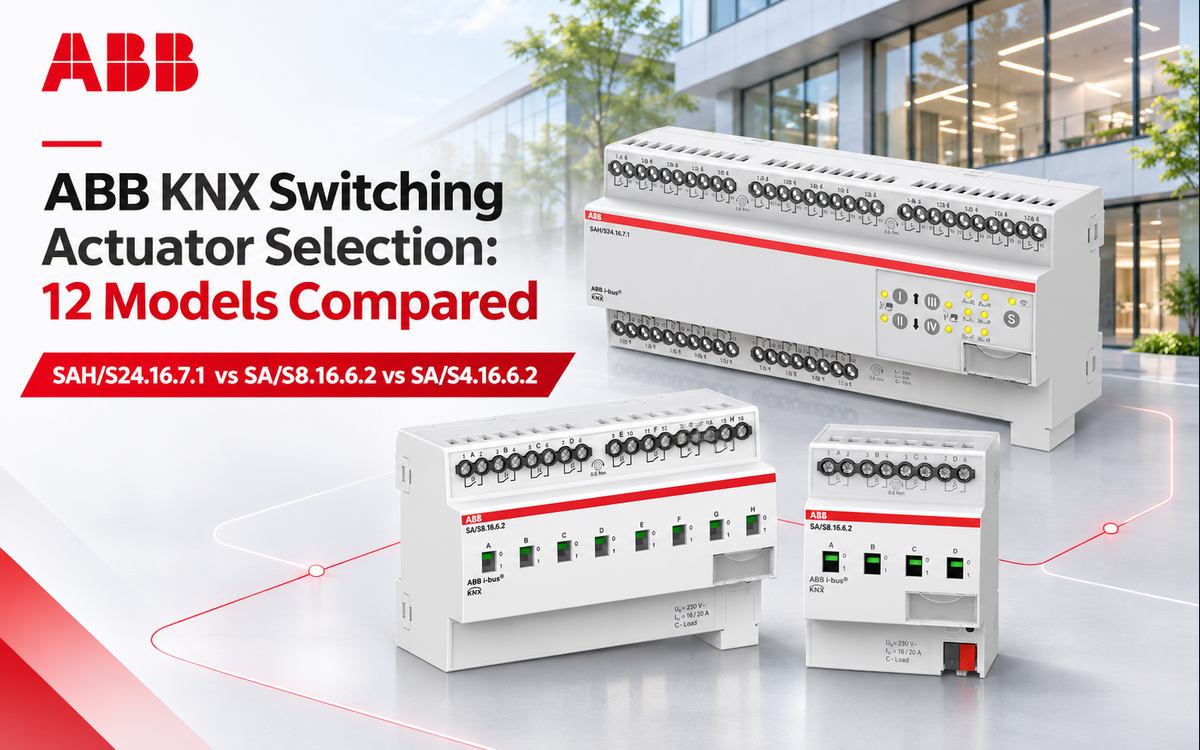
Selecting an ABB KNX switching actuator starts with the electrical circuit schedule, not simply the number printed on the front of an actuator. A robust selection connects each planned circuit to an independently controlled output, then checks the load category, start-up current, cabinet space and commissioning requirements. ABB offers Standard, Professional, energy-monitoring and Combi switch actuators, as well as flush-mounted solutions for individual locations. This guide compares twelve exact ABB models and shows how those categories translate into project decisions.
Start with the circuit schedule and load characteristics
For every controlled circuit, document the supply voltage, normal current, load technology, switching frequency and whether independent control is required. A lighting group with multiple LED drivers is electrically different from a resistive heater even when its continuous power appears low. ABB explains that LED driver input capacitors can cause high switch-on current, making inrush behavior a separate selection condition from normal operating current. See the manufacturer’s ABB KNX switching actuator technical presentation (slides 14–16).
Keep output counts aligned with the bill of quantities. A lighting circuit controlled together normally occupies one switching channel; circuits requiring independent schedules or scenes require separate channels. Then include space for any control outputs that may be added at fit-out. This exercise distinguishes an appropriate multi-channel distribution-board actuator from a compact flush-mounted actuator installed close to a load.
ABB switch actuator ranges: what changes in project design?
Standard switching outputs
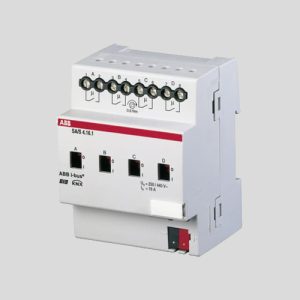
ABB Standard SA/S units are intended for general switching duties. In this selection, SA/S2.10.2.2 provides two 10 A channels, while SA/S12.16.2.2 provides twelve 16 A channels. A twelve-output block is attractive when the circuit schedule contains many independently controlled branches in the same distribution board. The manufacturer’s SA/S12.16.2.2 environmental declaration identifies twelve potential-free independent switching relays for that exact model.
Professional C-load switching
The Professional SA/S models in the ABB selection matrix address more demanding capacitive switching. SA/S2.16.5.2, SA/S4.16.5.2 and SA/S12.16.5.2 provide two, four and twelve outputs respectively. ABB’s variant-specific table characterizes these devices as 16/20 A C-load models and lists corresponding load-category ratings. Their role is especially relevant where luminaires and drivers create significant starting currents.
Professional outputs with energy functions
The SA/S2.16.6.2, SA/S4.16.6.2, SA/S8.16.6.2 and SA/S12.16.6.2 combine the Professional switching class with energy-related functions. ABB documents per-output current measurement, calculated power, energy consumption and load monitoring in this .6.2 range. These functions can support commissioning checks, operational supervision and monitoring of circuits whose performance matters after handover. They are not a substitute for conventional electrical protection or accurate load-category selection.
Combi switching and shutter functions
The SAH/S24.16.7.1 offers 24 independent switching relays in ABB’s Combi range. In shutter operation, relay outputs are allocated in pairs to control twelve 230 V AC drives. ABB expressly distinguishes this software-interlocked pairing from mechanically interlocked blind actuators. When producing the channel schedule, count paired shutter control separately from individual switching circuits so that a nominal 24-output actuator is not treated as providing 24 independent blinds. The exact product is also identified in ABB’s Combi-range declaration.
Flush-mounted switching and switch/blind control
The SA/U1.16.2 is a one-output flush-mounted switching actuator with local binary-input capabilities, while SAH/U2.16.2 is a two-relay flush-mounted switch/blind device. ABB’s respective product manuals describe the relay operation and KNX communication functions. The switch/blind configuration uses its two relays as one motor-control pair when operating a blind. These compact alternatives suit distributed control points where a centralized cabinet output is not the preferred electrical architecture.
ABB KNX switching actuator comparison by verified model characteristics
| ABB model | Documented output count | Product class |
|---|---|---|
| SAH/S24.16.7.1 | 24 | Combi switching/shutter |
| SA/S8.16.6.2 | 8 | Professional with energy functions |
| SA/S4.16.6.2 | 4 | Professional with energy functions |
| SA/U1.16.2 | 1 | Flush-mount switching actuator |
| SA/S2.10.2.2 | 2 | Standard switching |
| SA/S12.16.6.2 | 12 | Professional with energy functions |
| SAH/U2.16.2 | 2 | Flush-mount switch/blind actuator |
| SA/S12.16.5.2 | 12 | Professional C-load |
| SA/S2.16.6.2 | 2 | Professional with energy functions |
| SA/S12.16.2.2 | 12 | Standard switching |
| SA/S2.16.5.2 | 2 | Professional C-load |
| SA/S4.16.5.2 | 4 | Professional C-load |
The model and output mapping above follows ABB’s exact-device order-code references, associated environmental declarations and the flush-mounted product manuals. For the switching-class distinction, the manufacturer’s variant-specific selection table also separates Standard devices from Professional C-load devices and Professional models with energy functions.
Why inrush current changes the actuator decision
LED luminaires contain drivers whose input behavior may produce a short current peak when energized. A circuit’s steady-state current therefore does not describe every relay stress condition. ABB’s own selection discussion highlights LED inrush and gives load-category tables for Professional 16/20 A C-load variants. For these products, electrical design should consider both the relevant switching category and the driver manufacturer’s inrush data, including the number of drivers energized on one relay.
The difference also appears with motor loads, contactors and large capacitive supplies. A relay rating given for one utilization category cannot be substituted for an unrelated utilization category. At the detailed-design stage, compare the actual circuit schedule with ABB’s model-specific switching capacity information and the connected equipment’s electrical data. If several loads operate simultaneously, assess their combined energization behavior rather than summing only their nameplate power figures.
Distribution-board layout and circuit grouping
Group channels by electrical function before choosing a cabinet actuator. A project may separate corridor lighting, tenant areas, mechanical plant and shading. Doing so improves documentation and allows ETS group addresses and panel labels to correspond to real controlled circuits. When multiple channels share a cabinet, the panel designer must also consider terminal access, distribution arrangements, protective devices, heat dissipation and service access.
A large output count can reduce the number of KNX devices in the distribution board, but the optimal layout is not necessarily the one with the fewest housings. Circuit separation, fault isolation and future reconfiguration remain important. The twelve-output SA/S12.16.5.2 and SA/S12.16.6.2 provide two different professional-range paths: one centered on C-load switching and the other adding energy-related monitoring.
Three-phase circuits and motor switching
ABB’s engineering presentation warns that separate KNX switching relays do not guarantee simultaneous operation of all phases of a three-phase load. Where simultaneous switching is a required safety or functional characteristic, ABB recommends an external installation contactor controlled by an actuator output. This distinction is particularly important for motor loads and other circuits where phase coordination is essential. See the ABB engineering guidance on three-phase loads (slide 15).
Shutter drives require a different form of coordination: an actuator must prevent contradictory up and down commands. ABB explains that its SAH/S Combi outputs use software interlocking when configured in pairs, while a dedicated shutter actuator may offer mechanical interlocking. This distinction should remain visible in the motor-control design, especially when assessing safety functions and maintenance behavior.
ETS commissioning and handover checks
Good KNX actuator selection continues into commissioning. Assign physical addresses and group addresses according to the approved electrical schedule, label each output and test every load at the panel. Verify normal commands, scene behavior and defined behavior after KNX bus voltage interruptions. For devices equipped with energy functions, use the manufacturer’s documented monitoring features to inspect connected circuit behavior after energization.
ABB describes ETS template functions and its Update Copy Convert app for managing repeated channel configurations. These capabilities help keep settings consistent across a multi-channel installation. The commissioning record should distinguish the installed model, channel assignment, application version, protected circuit and actual load. Those details make subsequent troubleshooting and alterations more reliable.
A practical selection workflow for a KNX bill of quantities
- List each independently controlled load and identify whether its function is switching, shading or monitoring.
- Assign switching channels and paired motor outputs before calculating total device quantity.
- Check load categories, operating current and energization behavior against the relevant manufacturer model data.
- Choose between Standard, Professional C-load and energy-function models according to the circuit requirements.
- Confirm distribution-board space or the preferred flush-mounted installation location.
- Document ETS group addresses, channel labels, scenes, power-loss reactions and commissioning tests.
Browse the complete KNX switching actuator range or explore ABB KNX products to compare the available device options by exact order code.
Final selection guidance
For a compact two-circuit project, a two-output actuator may offer the simplest channel assignment. Larger boards can benefit from four-, eight- or twelve-output SA/S devices. Where connected LED drivers or other capacitive loads create demanding switching conditions, the Professional C-load range provides a differentiated electrical switching class. Energy-function variants additionally support operational measurements, while SAH/S and flush-mounted switch/blind products address mixed switching and shading requirements.
The essential rule is consistent: first define the load and required function, then select the independently documented ABB order code. Channel count determines how many circuits can be controlled, but load category and the architecture of the installation determine whether those outputs are appropriate for the task.